The “Open Concept” Lie We All Fell For
I’m going to be honest with you because nobody else on Instagram will.
I blame HGTV.
Somewhere around 2012, we collectively decided walls were the enemy. We took sledgehammers to our privacy, screaming about “flow” and “sightlines,” until we woke up in 2024 realizing a terrible truth. Walls were actually useful. They gave us a place to hide our shame.
Now? You open the front door and—boom—you’re basically standing on the sofa.
The delivery guy sees your unwashed dishes. Your guests walk straight into the intimate chaos of your living room. There is no pause. No breath. No transition between the gritty, loud outside world and your sanctuary.
It’s exhausting.
You kick off your shoes and they tumble into the middle of the floor. You drop your keys on the dining table. The mail ends up on the kitchen counter, soaking up grease spots from last night’s pizza box.
If you are renting a studio or living in one of those “modern” condos that maximized square footage by deleting the hallway, you know this pain. But you don’t have to live like a frat boy. You can lie.
You can build a fake entryway. And you don’t need a contractor to do it.
Why Zoning is More Important Than Square Footage
So, why does this matter?
It isn’t just about aesthetics. It’s about psychology.
When you walk through a door, your brain needs a signal that the context has changed. It’s a concept called “threshold crossing.” Without a physical barrier or a visual cue, that switch doesn’t flip. You bring the stress of the commute right onto your rug.
Creating a fake entryway is about manipulating the eye.
You are forcing people (and yourself) to pause. You are creating a “drop zone.” A place where the outside grime stops and the inside comfort begins. Even if that zone is only three square feet of drywall and floorboards, it counts.
The goal isn’t to build a wall. It is to build a speed bump.
The Tactics: How to actually Pull This Off
Let’s get into the weeds. I’ve seen people try this and fail because they buy a tiny rug and call it a day. That doesn’t work. You have to be aggressive with your furniture placement.
1. The “Back-to-the-Door” Sofa Layout
This is my favorite trick, and I use it in almost every small apartment consultation I do.
Most people instinctively shove their sofa against the longest wall. Stop doing that. It makes your apartment look like a bowling alley.
Instead, float the sofa.
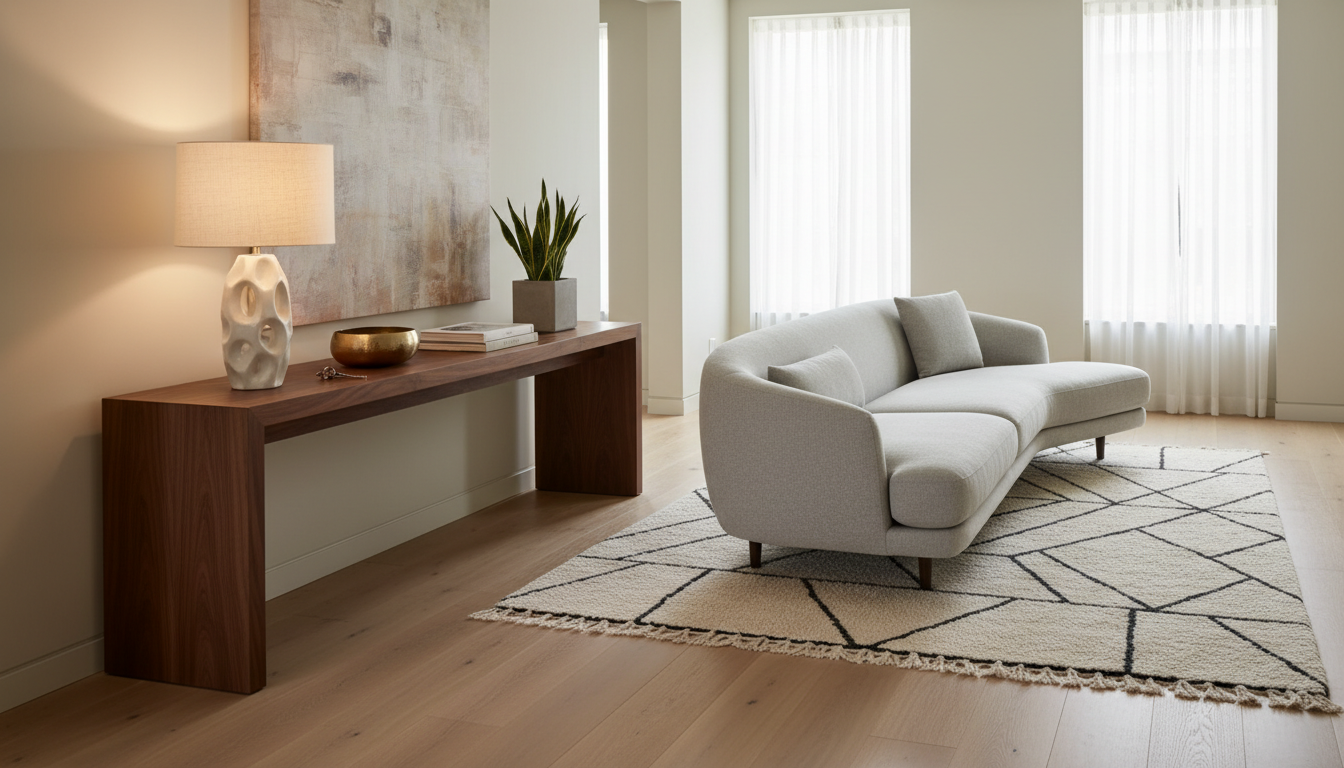
Position the back of your sofa so it faces the front door. Leave about three or four feet of walking space between the door and the sofa back. Suddenly, you have a corridor. You have created a physical barrier that says, “The living room starts here, not there.”
But you can’t just leave the naked back of a sofa exposed. It usually looks unfinished.
You need a console table.
Push a long, skinny console table right up against the back of the couch. This is the anchor. It gives you a surface for a lamp, a tray for keys, and maybe a stack of books. Visually, it acts like a half-wall.
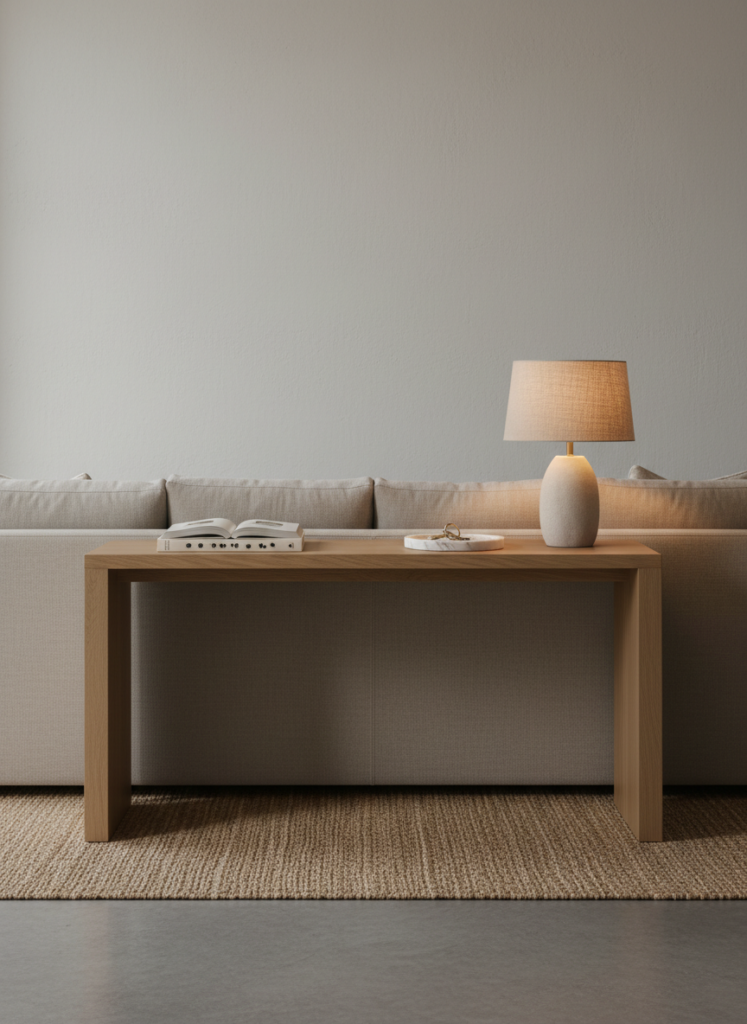
Important: Make sure the console table is slightly lower than the sofa cushions. If it sticks up over the top, it looks sloppy.
2. The Rug Defines the Territory
If you can’t float your furniture because your room is the size of a postage stamp, you have to use the floor.
You need a rug. But not just any rug.
Do not—I repeat, do not—put a high-pile, fluffy Moroccan rug at your front door. It will trap mud, street grit, and moisture, and within three weeks it will look like a dead animal. It is disgusting.
You want a flat-weave.
Jute, sisal, or a heavy-duty wool dhurrie. These materials are tough. They say, “Walk on me with your dirty boots, I don’t care.”
The placement is key here.
Orient the rug perpendicular to the door if possible. It creates a “runway” effect. The moment your feet hit that specific texture, you know you are in the entry zone. When your feet transition to the hardwood or the softer living room rug, you know you have entered the home.
Use rug tape. Nothing ruins the illusion of a sophisticated apartment faster than tripping over a curled rug corner and face-planting into your TV stand.
3. Verticality: The “Hook Wall”
Floor space is expensive. Wall space is free.
If you have a blank wall next to your door, abuse it.
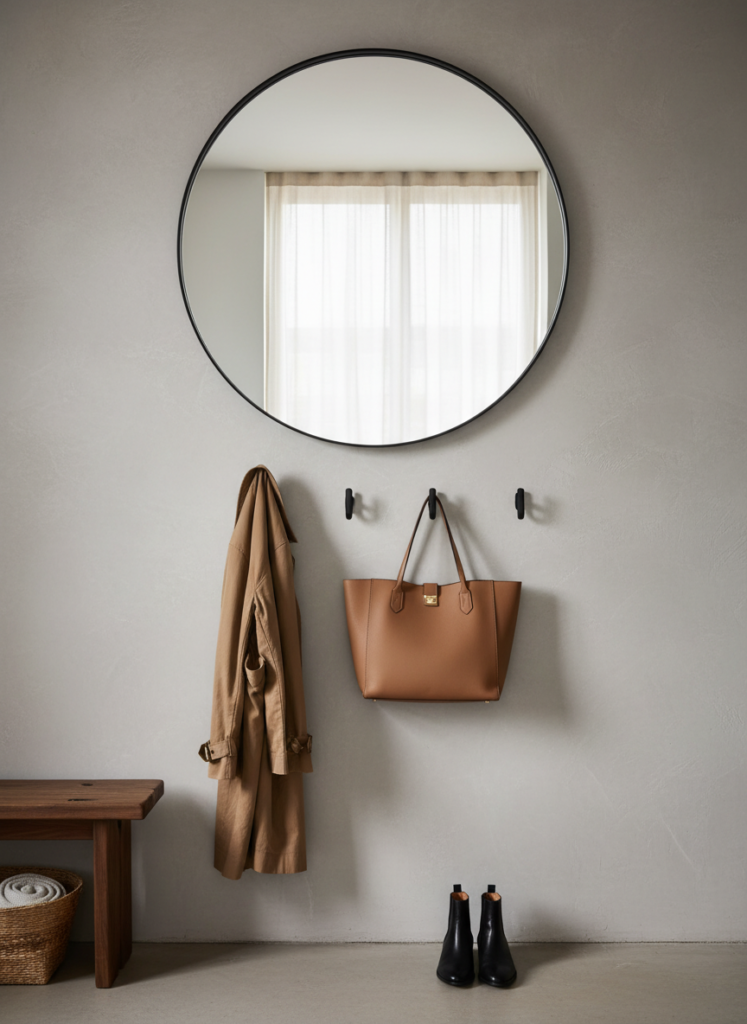
Install a row of hooks. But don’t just buy those cheap, plastic adhesive ones that fall off when you look at them wrong. Get a solid rail of wood with heavy metal hooks. Or install individual, architectural hooks at varying heights.
Why varying heights?
Because you have bags. You have scarves. You have dog leashes. If everything hangs at exactly 60 inches, it creates a bulky mass of fabric that looks like clutter. Stagger them.
Above the hooks, you need a mirror.
This isn’t vanity. Well, it is a little bit of vanity (checking your teeth before a date is important). But mostly, a mirror reflects light.
Entryways in apartments are usually dark, cavernous corners. A mirror bounces whatever natural light you have back into that dark corner, making it feel intentional rather than like a dungeon.
4. The Shoe Cabinet Miracle
Let’s talk about the IKEA Trones or Hemnes shoe cabinets.
I know, I know. Every interior design blogger talks about them. You are sick of hearing about them.
But there is a reason they are ubiquitous. They are shallow.
Most dressers or credenzas are 18 to 20 inches deep. In a fake entryway, 20 inches is a mile. It blocks the flow. You’ll be hip-checking that dresser every day until you are covered in bruises.
The IKEA shoe cabinets are often less than 7 inches deep. They hug the wall. They disappear. Yet, they swallow the clutter that makes a small apartment feel trashy: sneakers, mail, dog poop bags, spare keys.
Hack it.
Don’t just leave it white plastic. Buy a piece of wood from the hardware store, stain it a dark walnut, and glue it to the top. Now it looks like custom furniture. It looks expensive.

5. Lighting the Zone
You cannot rely on the “boob light” flush mount fixture that came with your apartment. It casts a sickly, yellow interrogation-room shadow that makes everyone look tired.
You need a dedicated light source for your fake entry.
If you did the console table trick I mentioned earlier, put a lamp on it. A table lamp with a shade creates a pool of warm light.
When you come home late at night, turn on only that lamp. It creates a cozy, welcoming vibe. It separates the entry from the dark living room.
If you don’t have a console table, use a wall sconce. You don’t need to hardwire it. There are plenty of battery-operated or plug-in sconces now. Mount it right next to the door. It acts as a beacon.
6. Paint as a separator
If your landlord allows it (or if you are sneaky and good at painting it back before you move out), paint the door.
Or paint the wall surrounding the door.
Color blocking is a massive trend right now, but for a fake entryway, it serves a functional purpose. If you paint a distinct arch or a rectangle of moody charcoal or deep green around your door, you are visually carving out that space.
It tells the eye: “This colored section is the mudroom. The white section is the living room.”
It costs thirty dollars for a quart of paint and takes an afternoon. The impact is disproportionate to the effort.
Where You Will Likely Mess This Up
I have seen people follow all these tips and still end up with a mess. Here are the three ways you will likely sabotage yourself.
1. The “Pinterest Clutter” Trap
You see a photo of a styled entry. It has a wicker basket, three throw pillows, a lantern, a plant, and a vintage sign.
You buy all of that.
Now you can’t open your door all the way.
Stop it. A fake entryway in a small apartment needs to be ruthless. If an object does not serve a function (holding shoes, holding keys, lighting the space), it does not belong there.
You do not have the luxury of decorative filler. Your space is premium real estate. A dried pampas grass arrangement that gets caught in your zipper every morning is not “boho chic.” It is annoying.
2. Ignoring the “Drop Zone” Reality
You can buy the prettiest console table in the world. But if you don’t put a bowl on it, your keys will end up on the floor.
If you don’t have a specific tray for mail, the mail will migrate to the kitchen island.
We are creatures of habit. Laziness always wins. If you do not create a specific, easy-to-reach vessel for the things you carry in your hands, the system fails.
Get a bowl. Get a tray. Make them big enough to actually hold your stuff.
3. The Scale Problem
This is the most common sin in interior design.
People in small apartments buy tiny furniture because they think it makes the room look bigger. It does the opposite. It makes the room look like a dollhouse.
A tiny rug looks like a postage stamp. A tiny mirror looks cheap.
Go big.
Get a rug that is wide enough that you can stand on it with both feet. Get a mirror that creates a statement. One large piece of furniture (like a substantial shoe cabinet) looks less cluttered than four tiny, flimsy stands.
Get to Work
You don’t need a renovation budget. You don’t need to knock down walls or build new ones.
You just need to stop accepting the “open concept” default.
Your home should protect you. It should greet you. It shouldn’t just be a continuation of the hallway.
Define the space. Put down a rug that can take a beating. Turn the sofa around.
Create the separation you deserve.